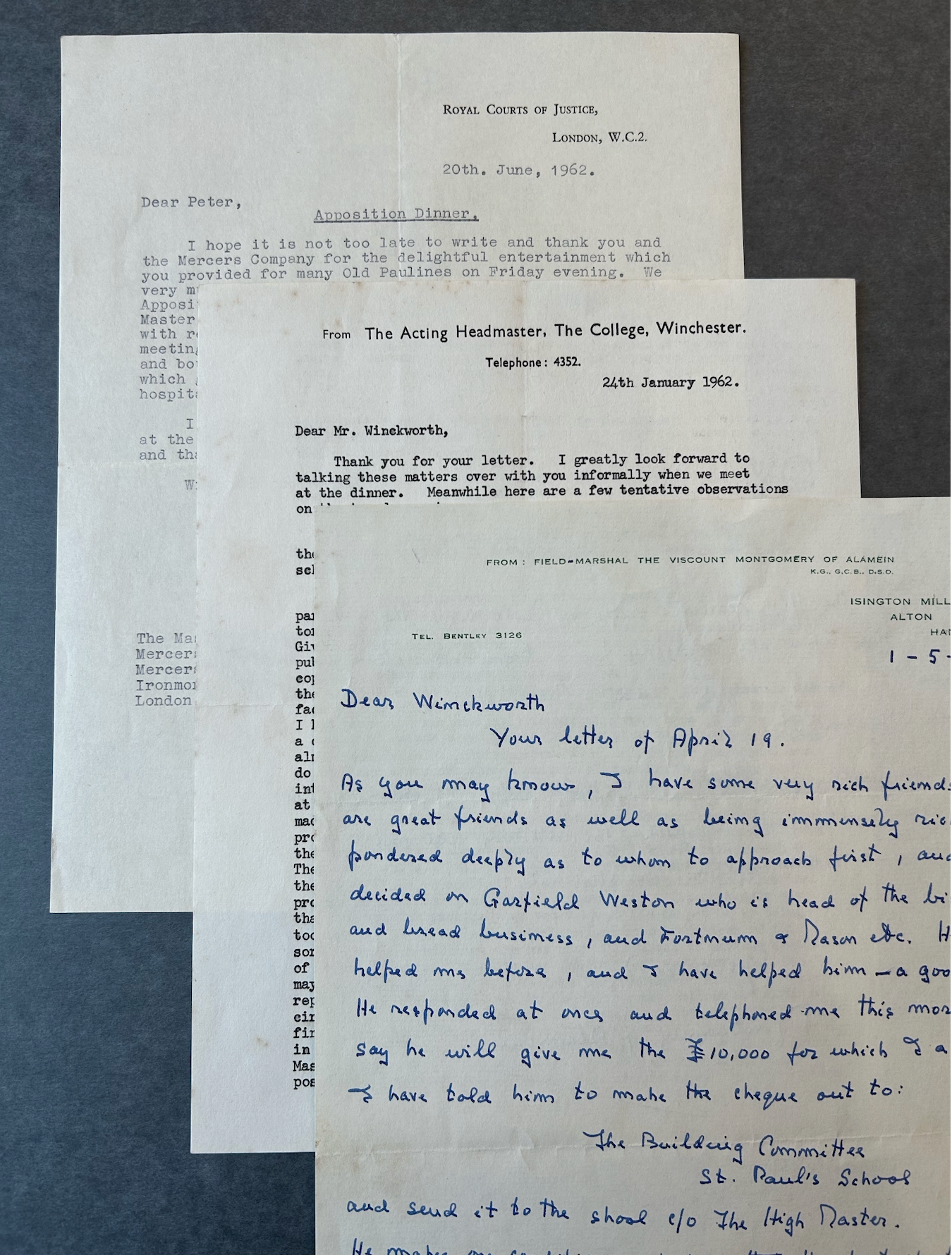
Kelly Strickland, Archivist, writes: These 12 letters were part of a larger collection of correspondence to Peter Winckworth, Governor of St Paul’s School and Master Mercer. We were offered this set of letters that relate directly to St Paul’s School and its alumni. Thanks to the grant from the Friends of the National Libraries we were able to acquire them.
Peter Winckworth was a Governor of the School from 1958 to 1973 and Master of the Mercers Company from 1961 to 1962. He was a Governor at an important time in the School’s history as it was moving location for the fifth time. It moved from West Kensington to Barnes in 1968. Several of the letters touch on this topic and give insight into the thinking and planning behind the move.
Most of the correspondence is from two of the School’s High Masters, Anthony N. Gilkes and Thomas E.B. Howarth.
High Master Anthony Gilkes wrote to Mr Winckworth in 1962 about the School’s historic annual Apposition ceremony, suggesting prize-giving should be removed from the event.
A series of letters from Thomas Howarth reference the possibility of him leaving the School for another Headmastership, but ultimately he decided to stay and gives his reasoning. The Archives do not have much correspondence to and from High Master Howarth so this insight is illuminating. A
One letter that is particularly exciting for us is from Field Marshall Bernard L. Montgomery. Montgomery attended St Paul’s School from 1902 until 1905, and remained connected to the School throughout his life and also served as a governor. In a 1968 letter to Mr Winckworth, FM Montgomery writes about his efforts to raise funds for the new school building in Barnes. He also makes mention of the Montgomery Room, a meeting room named in his honour. This room remains an important meeting room for the school today with Montgomery’s portrait on the wall.
Other letters from notable Old Paulines include those from Lord Harry Louis Nathan in 1962, Sir Irving Blanchard Gane in 1962 and Sir Louis Halle Gluckstein in 1967. These letters praise various events and efforts by Winckworth and the School.
These letters give more insight into an important figure in the School’s history, but one who is not well known. With this acquisition we hope to learn more about an important time at the School.