
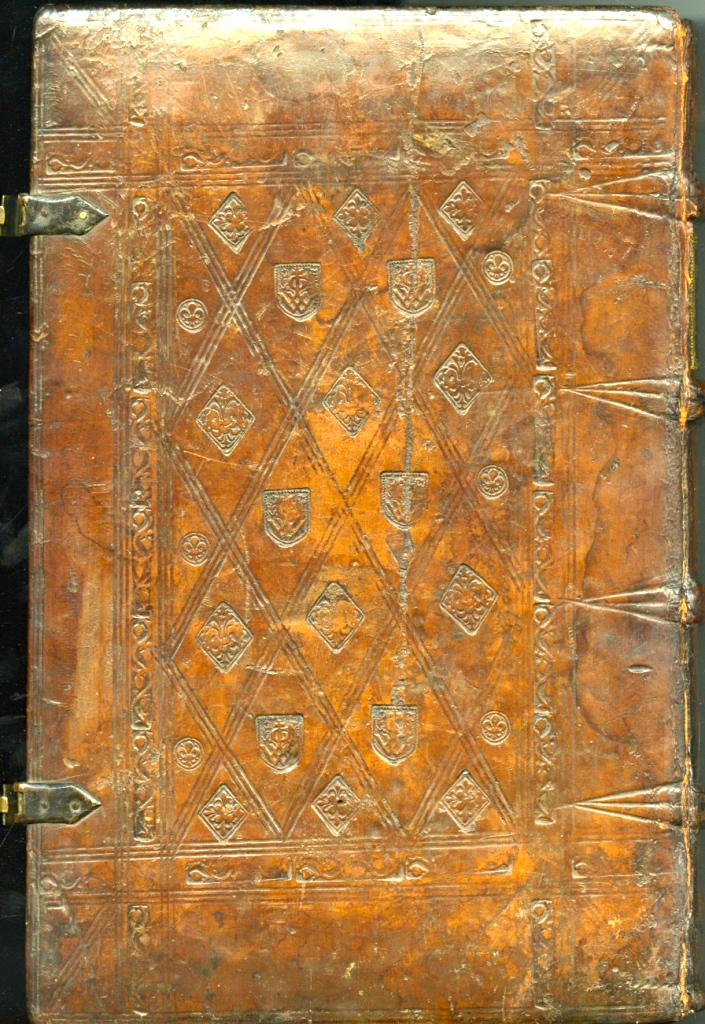
An edition of the complete works of the Latin grammarian Priscian, whose writings were used as the basis for the teaching of Latin grammar until the fifteenth century and as a source for extracts from classical authors whose works have otherwise been lost. Edited by Benedictus Brognolus, the well-known Venetian editor of classical texts and teacher of grammar, rhetoric and philosophy, and printed in Venice by Filippo Pinzi in 1492, it is currently recorded in only four UK libraries. The book is bound in contemporary blind-stamped calf over wooden boards, utilising a series of tools which have long been attributed to a bookbinder, or possibly bookseller, active in Cambridge in the fifteenth century. The binder, referred to as W.G. after the monogram found on his most distinctive tool, was active in Cambridge between c.1478 and 1507, indicating that the Priscian was in use in Cambridge within fifteen years of its printing.
Search FNL grants since 1931
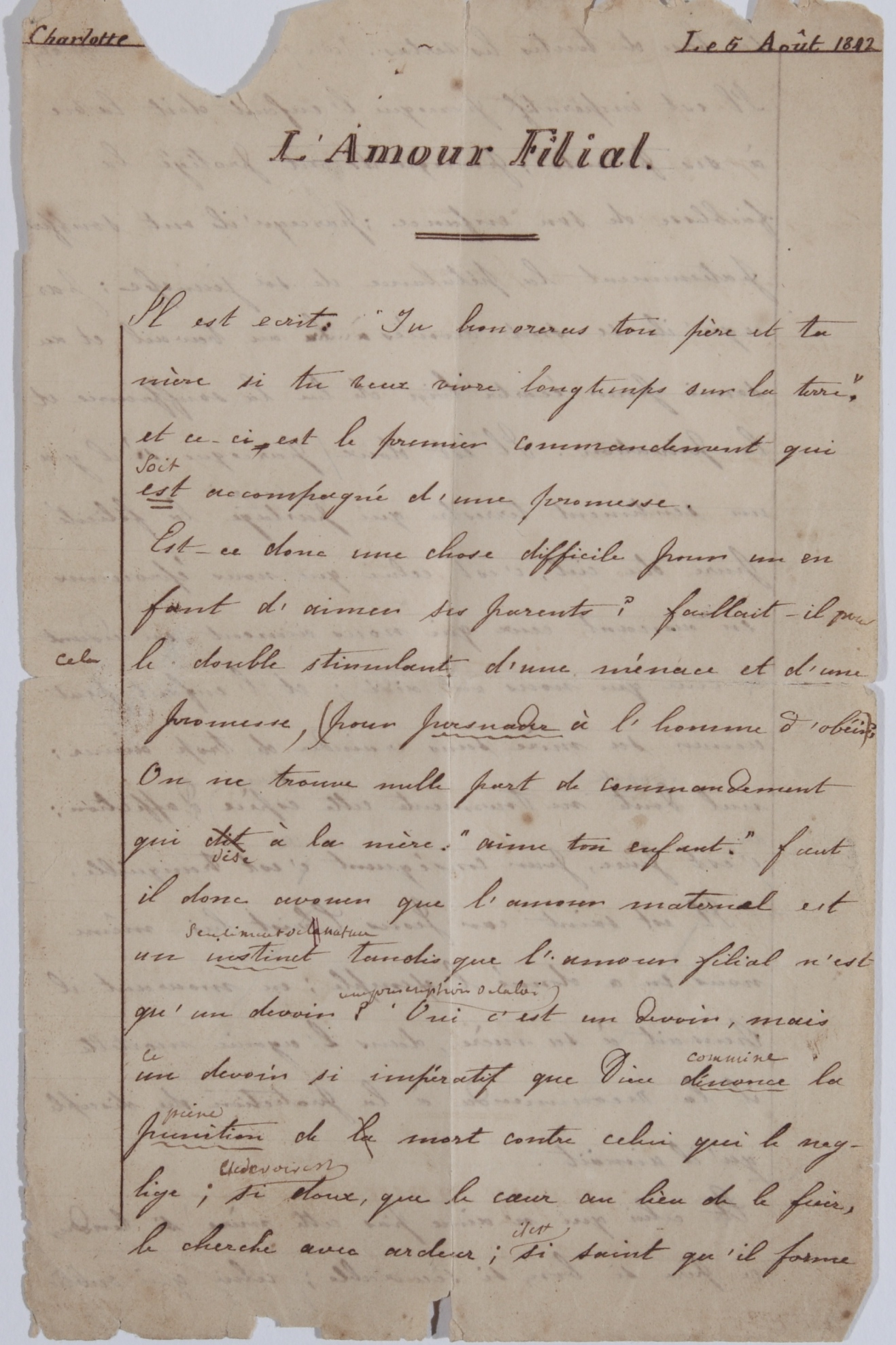
In February 1842, Charlotte and Emily Brontë became students at the Pensionnat Héger in Brussels. For the next nine months they worked unrelentingly, producing a series of devoirs (homework essays) in response to instructions given by their tutor, Constantin Héger.
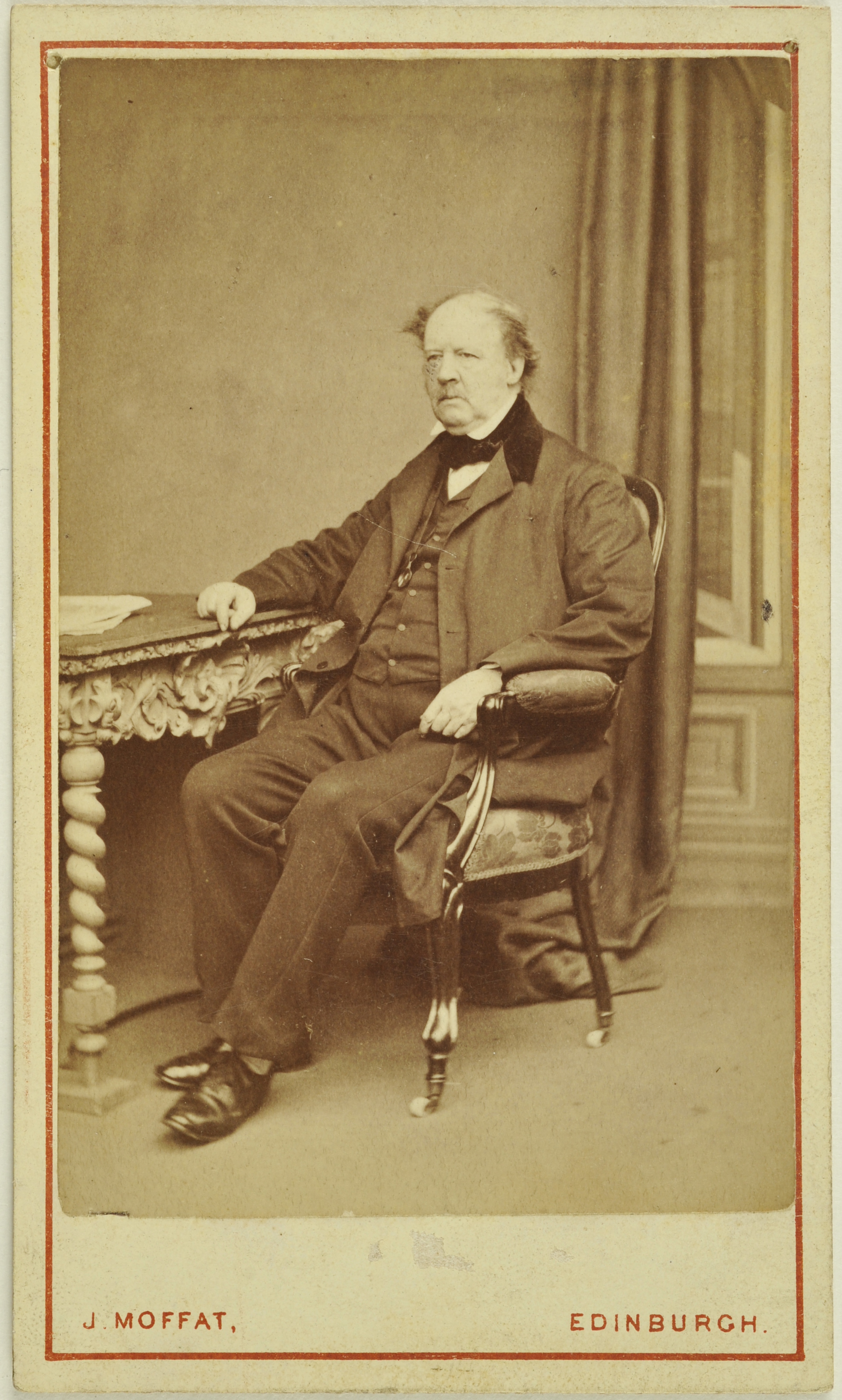
The last significant portion of material in private hands relating to Henry Talbot, pioneer of photography. While Talbot is best known today for his invention of two photographic processes - the photogenic drawing, announced in 1839, and the calotype, patented in 1841 - his achievements went far beyond photography. He published nearly seventy works in fields including electricity, optics, physics, mathematics, etymology, philology, classics, Assyrian, and photography, some of which remain at the forefront of research today. He was one of the first scholars to decipher cuneiform, and served as Member of Parliament for Chippenham. The Personal Archive spans his wide interests and areas of scholarship, offering a wealth of manuscripts, printed material, photographs, albums, and artefacts that illumine the private, social, and intellectual spheres that informed the discoveries of this Victorian polymath.
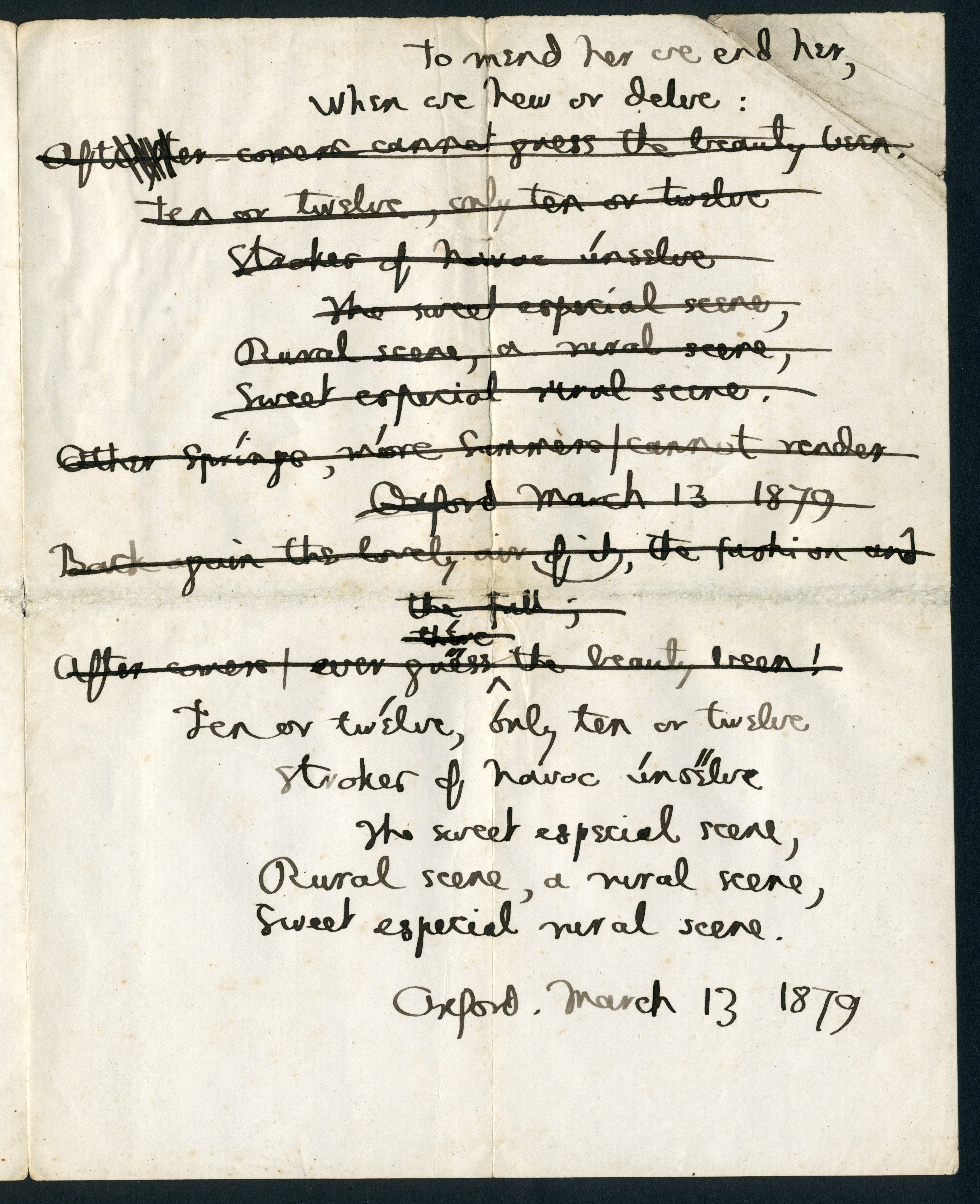
a late autograph draft manuscript of Gerard Manley Hopkins’ celebrated poem 'Binsey Poplars'. The last known major Hopkins manuscript to have been in private hands, ‘Binsey Poplars’ was the most significant Hopkins item to have come to the market in over forty years.
The bulk of the collection consists of letters written by William, Percy and Sydney Spencer, three of the brothers of Stanley Spencer, the artist, mostly written to their sister Florence Image (aunt of Pamela, to whom they ultimately descended).
This volume from the library of William Beckford (1760-1844) is bound with the distinctive Beckford Fonthill binding, which combines two motifs from Beckford’s coat of arms on the spine. Tipped in to face the title-page is a fine wash drawing of Amiens Cathedral with the pencil note below: ‘after a finished Sketch by W[illiam] B[eckford]’. Beckford was known to have been in France during 1806, the year Rivoire’s work was published, and the intriguing notation to the sketch of the building found in this volume invites speculation as to whether he visited and recorded the building using this work as a guide.
The possibility of this visit is made more significant because in 1806 Beckford was immersed in the construction of his Gothic Revival masterpiece Fonthill Abbey.
Beckford’s Tower and Museum currently has twenty-four volumes once belonging to Beckford, fourteen of which have Fonthill bindings. The acquisition of this volume adds to this small but significant element of the museum’s collection, which is displayed in cabinets originally designed by Beckford and the architect of the Tower for that purpose.
The item was printed in Edinburgh by James Ballantyne. The full title is 'The Ettricke Garland: Being Two Excellent New Songs on the Lifting of the Banner of the House of Buccleugh at the great football match on Carterhaugh Dec. 4, 1815'. It is comprised of a poem by Scott, ‘The Lifting of the Banner’, and Hogg’s own tribute, ‘To the Ancient Banner of the House of Buccleuch’, and it is amongst the rarest of either Scott’s or Hogg’s titles.
An unpublished letter written by Joseph Priestley, the scientist and Unitarian theologian, from Northumberland, Pennsylvania, to his close friend Theophilus Lindsey in July 1794.
A group of six carefully selected books.
These eight pocket sized engagement diaries belonging to Virginia Woolf record in brief the author’s daily appointments. They directly complement the holdings within the Monks House Papers which were given to the University of Sussex in 1972.