A Declaration of the afflictions and the persecution of the Protestants in the Marquisate of Saluce, belonging to the Duke of Savoy ...
Huguenot Society of Great Britain and Ireland
Four persecution tracts bound in one volume.

36 grants for 1999.
Four persecution tracts bound in one volume.
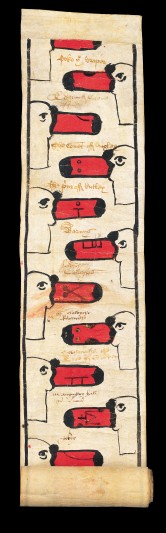
The earliest known Norfolk swan roll, hitherto unrecorded before its appearance at auction. There are 99 charming illustrations of swans heads in black and red ink with their distinctive ownership marks and the owners names written above.
This archive minutely documents the research and other activities of the British Surrealist Group. Includes a significant body of correspondence with Sir Roland Penrose and the poet David Gascoyne who were the prime movers in bringing Surrealism to Britain
An interesting collection of letters discussing German writers whose work might be suitable for publication by Faber and Faber. Eliot was clearly in favour of promoting German writers; Geoffrey Faber is very revealing on reading tastes and publishing difficulties in England in the 1920s and 30s
Kirk was Agent and Consul-General at Zanzibar and a major oponent of the Slave Trade. He accompanied David Livingstone on his second Zambezi expedition 1858 - 63 and took photographs which are preserved in this collection together with correspondence from Livingstone and PD Lugard, vividly describing the difficult early yeats of Uganda.
10 volumes, the major source and inspiration for Ruskins The Bible of Amiens, a combination of religious exposition and architectural history. This set was probably taken to France by Ruskin as there is a sketch of tracery in pencil on a flyleaf in volume 6, dated Beauvais 1888.
A very rare and early contribution to the subject of determining longitude, written by an Englishman resident in Hamburg, but printed, as far as it is known, only in this German translation, which is accompanied by an original English poem and a previously unrecorded world map. Illustrated at p.17 of AR
This account book is one of only three extant for rural parishes in Wiltshire dating from the reign of Henry VIII and it is by far the most detailed. The English reformation in microcosom is vividly documented in these pages.
Previously unknown to scholars, this is the farewell address of the first director of the RCM, whose wise guidance from 1882 soon made the College an important part of the musical life of the nation
The earliest map is the work of John Walker senior and his son for Thomas Mildmay, dated to about 1600. The second map, drawn by anothe r member of the Walker family, Samuel, was drawn for Sir Henry Mildmay in 1623.
An edition of grreat rarity, published in Moscow; only one other copy known in Western Europe. The letters, which are in typescript with handwritten greetings and comments by Brecht date from 1946 (the beginning of Brechts collaboration with his American translator) to 1955, a year before his death.
A valuable source for the study of 19th century silverware, being 300 pages of designs for objects such as broth basins, claret jugs, ice pails, muffin plates, sauce boats and tureens. The drawings are very detailed, and are accompanied by brief written descriptions and prices
190 volumes of detailed inventories and valuations dated between 1890 and 1966. The names, addresses and occupiers of every property are given, with room-by-room itemised lists of furniture, fittings, equipment and, in the case of commercial premises, stock-in-trade.
Number 84 of the edition of 142 copies signed by Bellmer with 15 of his mounted and hand-coloured photographs, with 14 prose poems by Paul Eluard written in response to the photographs 1938-39. Illustrated at p.25 of AR
A rich literary archive with a full series of the poets work books from the 1950s to 1994, with articles, reviews, broadcasts and lectures and much correspondence, including letters from TS Eliot, Hugh MacDiarmid, Neil Gunn, Norman MacCaig, Sorley MacLean, Iain Crichton Smith and many other poets, writers and publishers.
The archive of a working playwright, whose best known work A Day in the Death of Joe Egg , 1967, is still in production world wide.
30 notebooks of intensely reworked autograph drafts for Motions eight volumes of published verse, together with unpublished poems. Notes and drafts for his critical studies of Edward Thomas, Philip Larkin, John Keats, the Lamberts and William Barnes; there are also five volumes of reviews and other miscellaneous writings.
This document antedates the earliest surviving archives of Hastings Corporation by almost a century. It details the sufficiency and number of the men of Hastings ready to repel an invasion from France or Flanders from whence Perkin Warbeck had tried to invade a year earlier
Manuscript deeds of various properties at Chawton 1304 - 1525, together with a volume of transcribed deeds for Chawton 1547 - 1621. These considerably augment the papers already in the Record Office from the Knight family archive for the medieval period.
65 documents, many are letters addressed to Captain Thomas Brodnax of Canterbury and Godmersham Park, giving military commands and are signed by key figures including John Dixwell, one of the regicides. They provide information about day to day life in the parliamentary army with details about pay and the importance of exercising the troops.
The major part of the archive relates to the Henbury Hall estate, bought by Thomas Brocklehurst in 1875. The estate came with leases, rentals and maps dating back about 150 years; there are also papers relating to John Brocklehursts election as MP in 1859 and the establishment of the West Park Museum by the family to mark the Diamond Jubilee
Book made up for Burges, elaborately bound in black morocco, gilt. In it he records all his commissions, giving details of date, work, contractor, cost and client. His two principal clients at this time were the Marquess of Bute and himself.
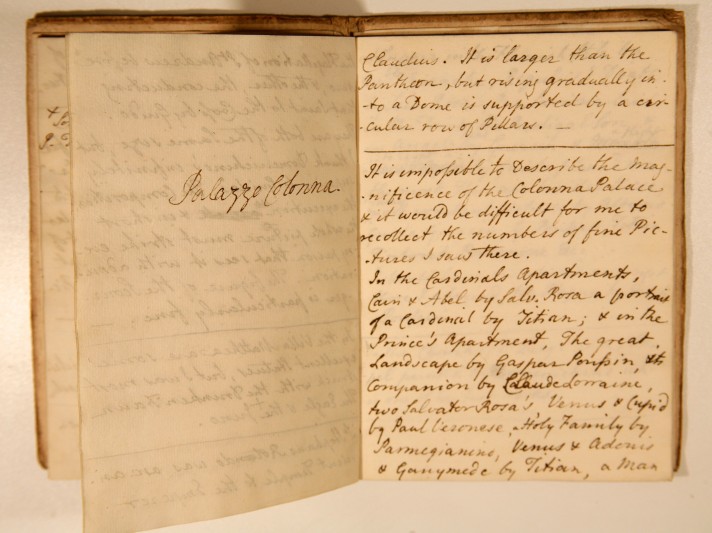
Manuscript journal of two tours made by Bunbury to Rome and to Florence, before he became well known as a caricaturist in London. The etchings published by Bretherton of Bunburys watercolours inspired by his foreign travels are often used today to illustrate the adventures of Grand Tourists and their bear leaders.
Collection of over 400 letters. 260 letters are from Robert, first Earl of Lytton to Kent, author and journalist, who helped Robert publish the life of his father Edward Bulwer Lytton. Kent was a family friend and also correspondend with Roberts wife Edith and their son Edward.
Letters patent, granting various properties in the parish of St Michael in Cornhill, London to Thomas Forster.
A remarkable series of 1285 letters, written by Masefield to Audrey Napier-Smith, violinist in the Hall orchestra, provides an invaluable record of the Poet Laureate in his last 15 years. A selection of the letters, omitting most of the personal and biographical material) was published as Letters to Reyna edited by William Buchan in 1983.
Molesworth was the founder of the philosophically radical London Review, which was supervised closely by Mill. The present letters provide a great deal of detail on the policy and development of the magazine, together with comments on individual articles and contributors.
A volume of meditations and directions on the Christian life, written shortly before the Civil War with a series of 11 illuminated initials, incorporating droll faces, decorated with flowers, leaves, acorns, grapes and ears of wheat in a charming naive style reminiscent of Stuart needlework. Illustrated at p.44 of AR
Copes own assemblage of evidence to be used in his defence at the Board of Enquiry which met to investigate the disastrous engagement with the Jacobite army at Prestonpans, of which he had been the General Officer commanding.
Copy of an original map of 1652, since lost. Made for Samuel Dixon when he took on the lease of the Wallingtons estate from Magdalen College, Oxford. A finely drawn and attractively coloured plan of the estate as it was in the mid 17th century with the house shown in elevation, other estate buildings, fields and woodlands.
An extremely rare account of the campaign of the Holy Roman Emperor Charles V against the corsair Khair al-Din, better known as Banbarossa, written throughout in clumsy ottava rima. The book was probably printed and published at Naples soon after Charless triumphal entry into the city
Seven letters from Jeckyll to Green, which provide a fascinating insight both into the designers intentions and into his relationship with his client, as well as sketches of furniture and other details.
Comprises a case book of male pauper lunatics 1873 - 75, and three volumes of post-mortem notes 1884 - 89, 1889 - 93 and 1900 - 02. The first post mortem register is particularly interesting since it contains sketches, often minutely detailed and coloured, made by the pathologist of his subjects brains and other organs.
The two main series of these documents relate to the selection of MPs and to the water supply of the town. The records include agreements to construct conduits and details of the pipes to be laid during the mid-16th century
Acquired together with a sketch book with drawings by Lady Frances Elizabeth Compton, presumably the pupil of JC Nattes. The drawings are generally ink or pencil sketches, most of the subjects topographical focusing on Castle Ashby and the surrounding countryside, though both also draw unexpected views of outbuildings and industrial features.
31 sheets bound in marbled boards containing drawings and sketches relating to several aspects of Gandys work both as an architect and as an antiquarian. There are drawings taken at Storrs in Windermere, Roslin, Melrose, Newcastle, Lancaster Church and Castle and Shrewsbury Market House.