Free Thoughts on Public Affairs
British Library
Presented by Arthur Gimson

Presented by Arthur Gimson
A volume of tracts containing nearly 50 poems in German or Latin on the death of leading citizens of Augsburg and othe related material.
An edition of grreat rarity, published in Moscow; only one other copy known in Western Europe.
Sue Wood, Head of Archives, writes: Dickson, Archer & Thorp were important Northumberland solicitors.
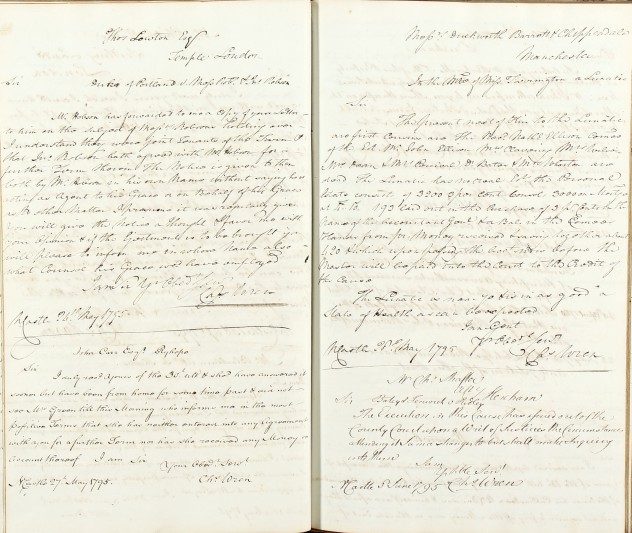
A hitherto unrecorded contemporary manuscript, finely bound in contemporary Dutch floral wrappers pasted onto boards with a calf backstrip. Written in three different hands, of which the two
The first German translation of Plutarch's Moralia, boun din contemporary German pigskin. Presented by Mr & Mrs Albert Ehrman
Fine large paper copy bound in contemporary red morocco gilt with the four magnificent proof plates engraved by Cazenare and Colibert
The Gale Morant Jamaican plantation papers cover the period from the late 18th century to the abolition of slavery in the British Empire in 1834 and beyond, when plantation owners were allowed to k
9 vols in 8, mint condition, over 250 coloured engravings; illustrated at plate II of AR
A valuable source for the study of 19th century silverware, being 300 pages of designs for objects such as broth basins, claret jugs, ice pails, muffin plates, sauce boats and tureens.
The Gaugains were a dynasty of minor painters and engravers of French origin but established in London by the mid-18th century. The present collection of letters of Philip Augustus Gaugain fl.
10 volumes containing detailed pedigrees and notes on the principal families of Shropshire.